6 July 2026
Gospel chord progressions every keyboard player should know
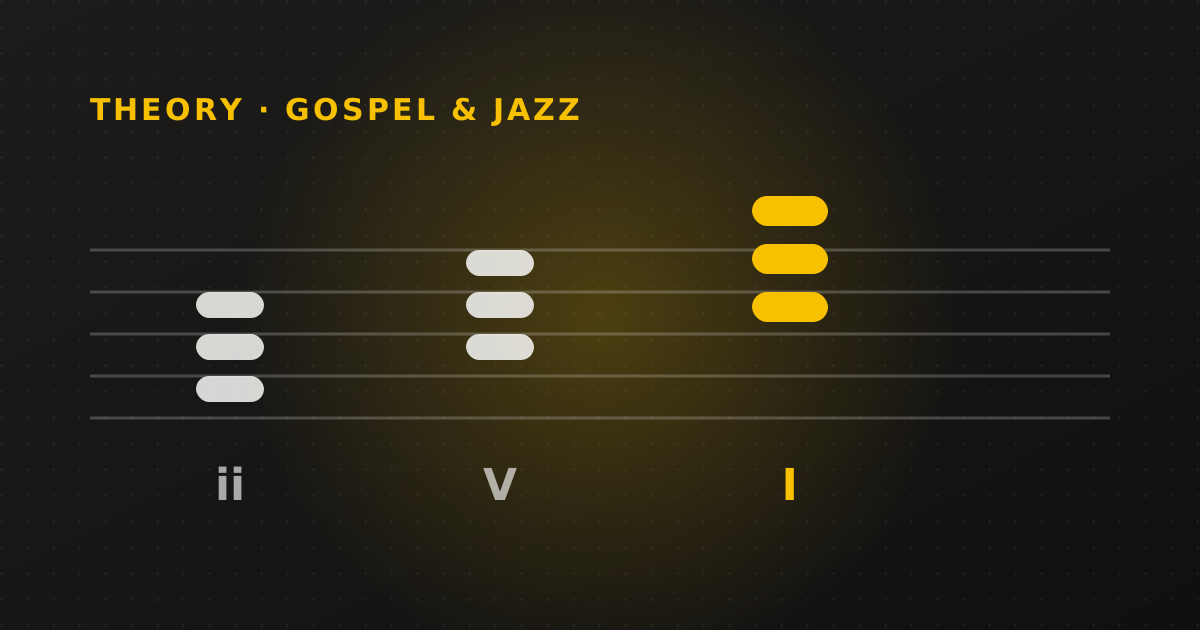
Gospel keyboard playing sounds complicated from the outside, but a great deal of it rests on a small number of progressions that recur constantly. Learn them as numbers rather than as fixed chords and you can play them in any key, follow a worship leader who modulates without warning, and work out most of what you hear by ear.
First, learn the numbers
Musicians name chords by their position in the scale rather than by letter, because the pattern is what travels between keys. In any major key, the seven chords are:
- I — major (the home chord)
- ii — minor
- iii — minor
- IV — major
- V — major
- vi — minor
- vii° — diminished
In C major that gives you C, Dm, Em, F, G, Am and Bdim. In F major it gives you F, Gm, Am, B♭, C, Dm and Edim. The numbers stay the same, which is the entire point. When a musician calls out "one-four-five" they mean the shape, not the letters — and in a worship setting where the key can change between songs, that is what lets you keep up.
The two-five-one
If you learn one thing, learn this. ii – V – I is the strongest resolution in Western harmony and it is everywhere in gospel and jazz alike. In C major: Dm to G to C.
It works because of tension and release. The ii sets up mild instability, the V sharpens it into something that genuinely wants to move, and the I resolves it. Your ear hears "arriving home" whether or not you can explain why.
Add sevenths — Dm7 to G7 to Cmaj7 — and it immediately sounds more like gospel and less like a hymn book. The seventh on the V chord is what creates the pull.
The one-four-five
I – IV – V is the backbone of congregational singing. In C: C, F, G. Plain, sturdy, and it holds a room of people together. Most worship songs live here or a short step away, and there is no shame in playing it straight when a congregation needs to follow you.
The one-six-two-five turnaround
I – vi – ii – V is how you get back to the top of a section without stopping. In C: C, Am, Dm, G. It loops seamlessly, which is why it sits under vamps, intros, and the long stretch where the preacher is still talking and the band is holding the moment.
Gospel players usually make the vi and ii dominant — C, A7, D7, G7 — which pushes each chord harder into the next and gives the loop that restless forward motion.
Passing chords: where gospel starts sounding like gospel
The difference between a progression that sounds like a hymn and one that sounds like gospel is usually what happens between the chords. Passing chords are short chords that connect two destinations.
Three that repay practice:
- Diminished passing chords. Slide a diminished chord between two scale steps — between the I and the ii, for instance — and the movement becomes smooth rather than blocky.
- Chromatic approach. Play the target chord a semitone above or below and slide into it. Simple, and instantly recognisable.
- Tritone substitution. Replace the V with a dominant chord a tritone away — in C, use D♭7 instead of G7. The bass then walks down by semitone into the I.
Voicing matters more than the chord
Two players can play identical chords and sound nothing alike. What separates them is voicing — which notes, in which order, spread how far apart.
A few habits worth building:
- Leave the root to the bass player and voice the colour notes — the third and seventh — in your right hand.
- Move as little as possible between chords. If two chords share a note, keep that finger still and let the others move.
- Keep your left hand out of the mud. Thirds low down sound thick and unclear; open them up or move them higher.
- Leave space. The rests are part of the arrangement.
How to actually practise these
Reading about progressions changes nothing. Playing them in one key changes very little. The work is this:
- Play the two-five-one in C until your hands stop thinking about it.
- Move it to F, then to G, then around the circle of fifths through all twelve keys.
- Add sevenths. Then add a passing chord between each pair.
- Put on a song you know and try to hear which progression is underneath it.
That fourth step is the one that turns theory into playing. Once you can hear the numbers, you can sit in with almost any band.
Learn it properly
Gospel keyboard is our speciality at JMG Music, and this is exactly what our keyboard and jazz students work through — in every key, with a teacher listening. Book a free trial lesson and bring a song you want to play.
Want to learn this for real?
Book a free trial lesson with JMG Music in Harare or online.
Book a free trial